Self-Hosted ML Infrastructure
Personal · Self-hosted infrastructure
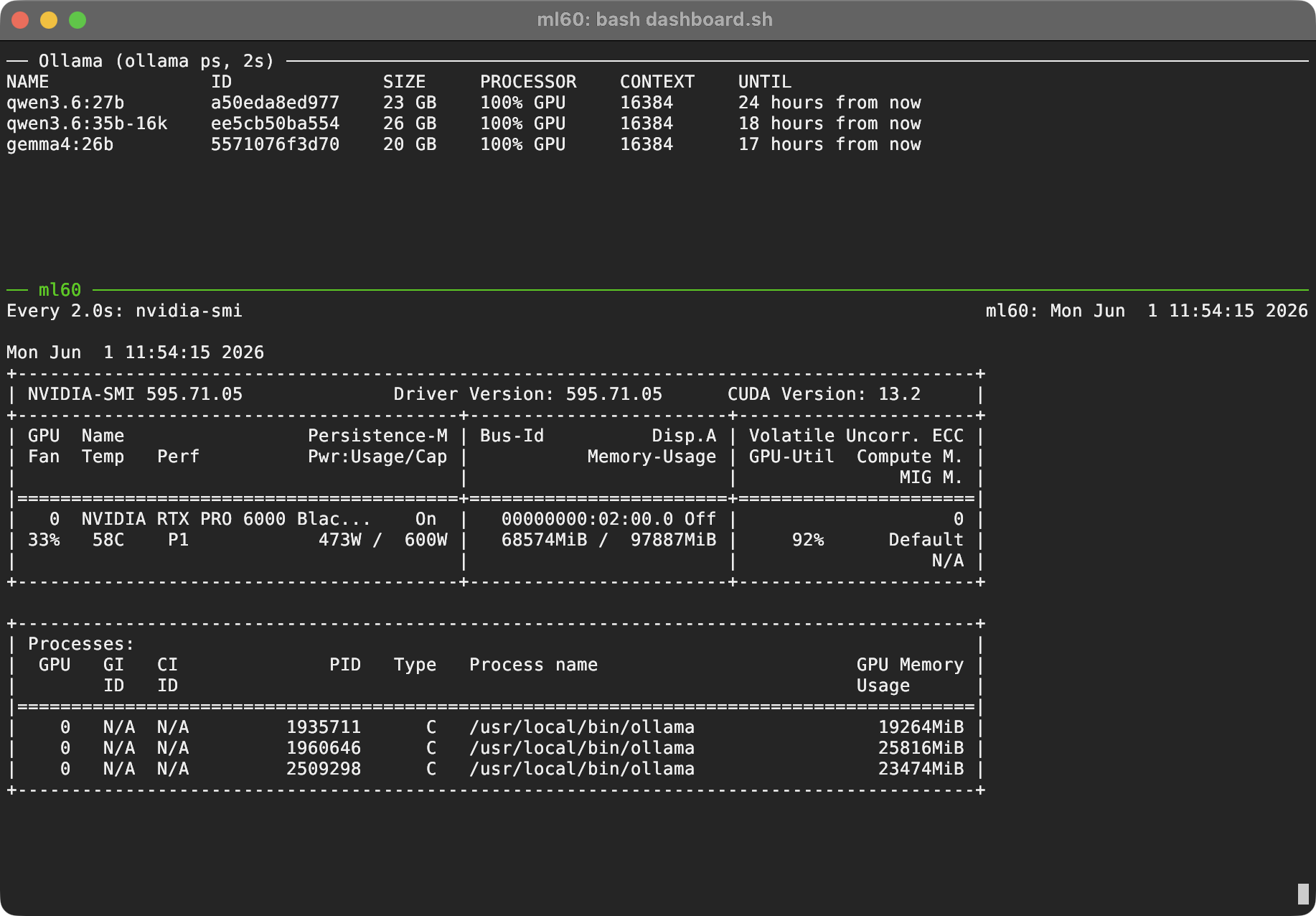
ollama ps and nvidia-smi.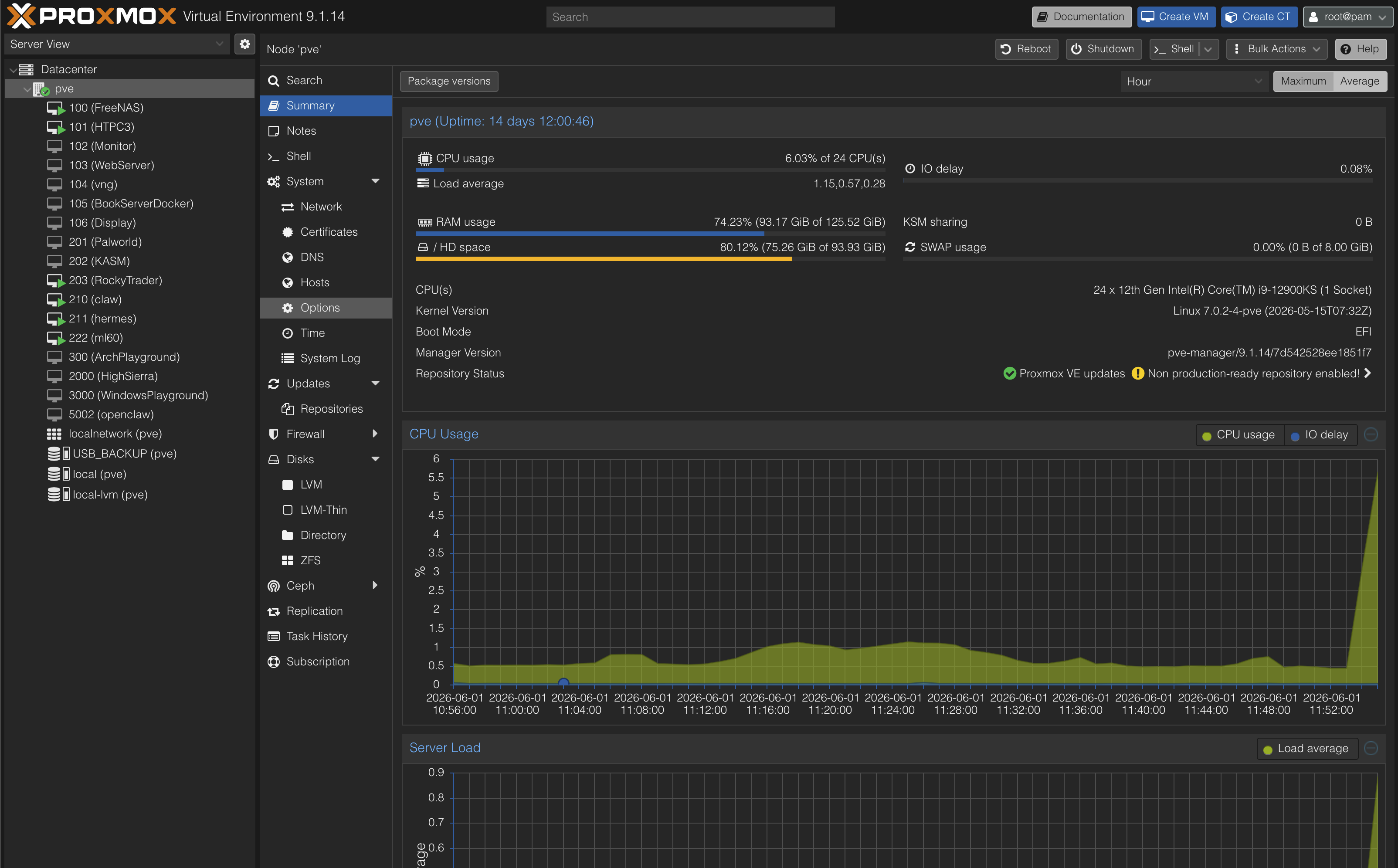
What it does
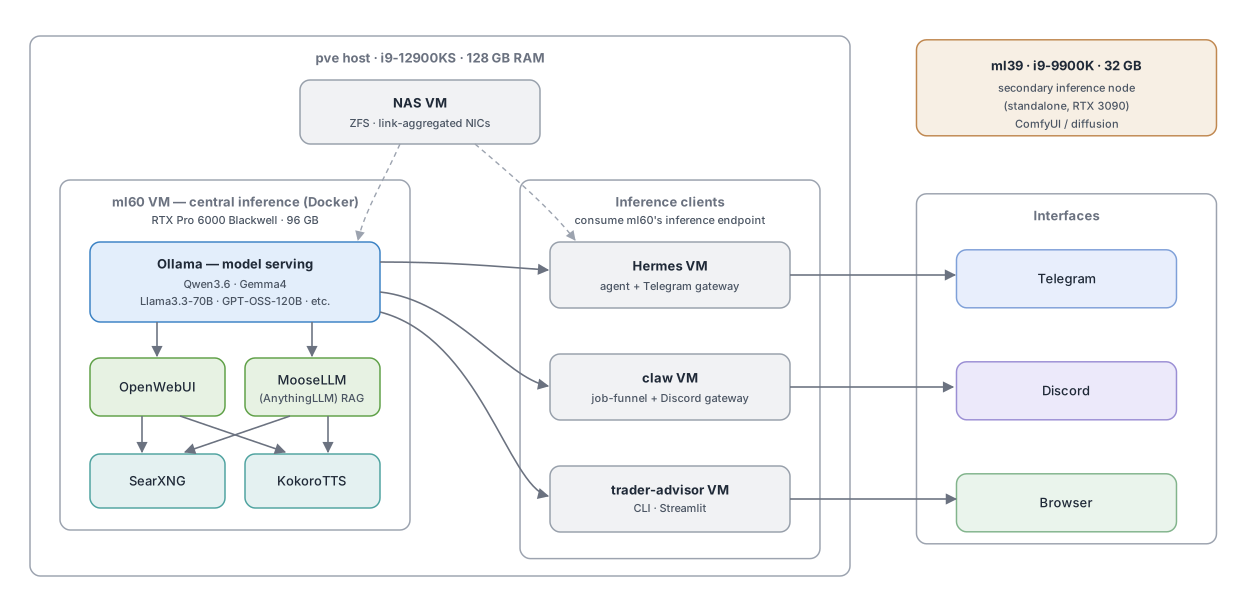
A self-hosted ML platform running entirely on my own hardware — local LLM serving, retrieval, agents, and multimodal generation, all local-first by default. Cloud providers (Anthropic, Google) are a pluggable option, not a dependency.
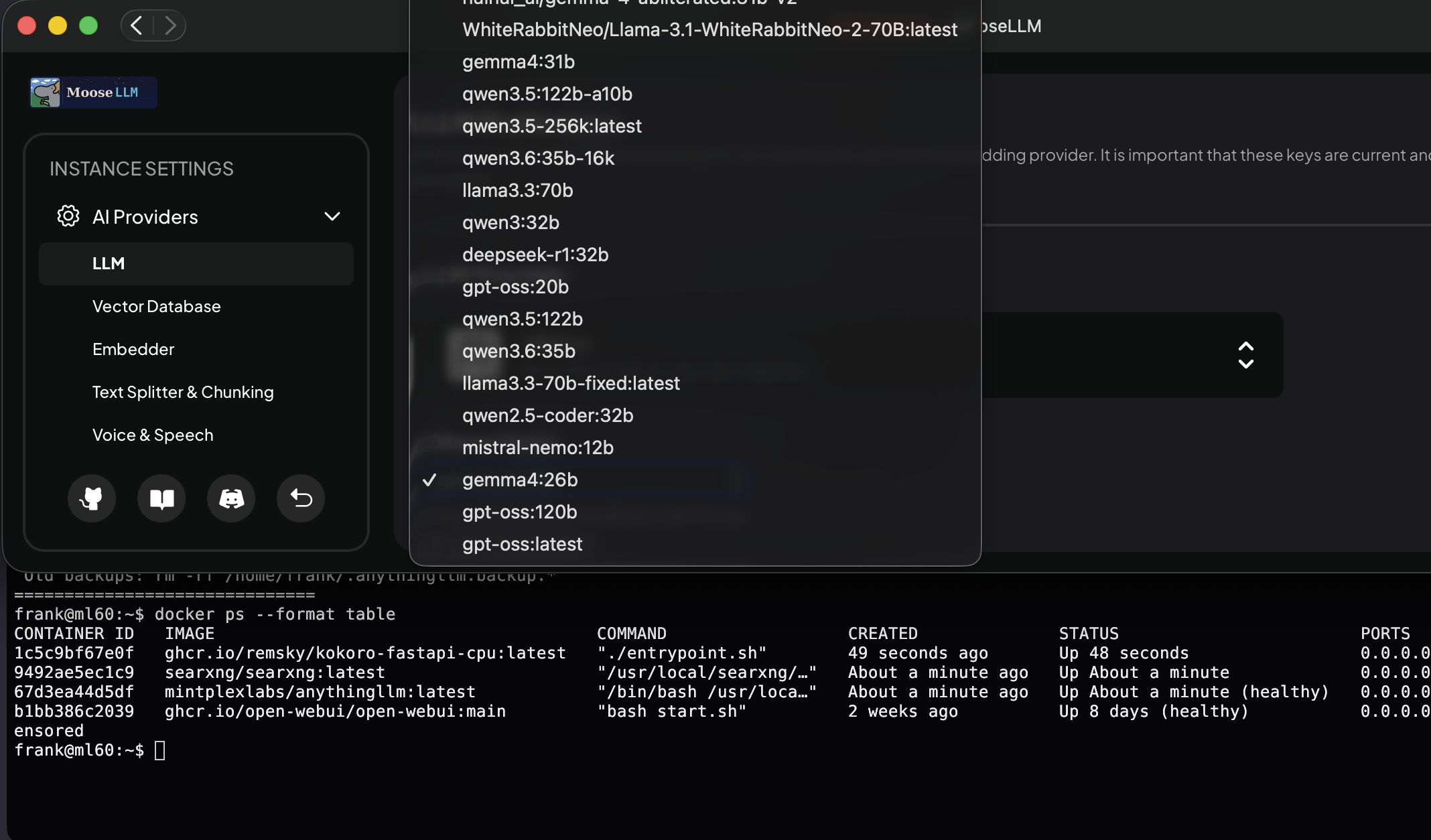
- Local LLM serving — a central inference VM runs Ollama as the model server, keeping several models resident at once (Qwen3.6, Gemma4, Llama 3.3 70B, GPT-OSS 120B, and others) and tuned for concurrency so multiple clients hit it in parallel.
- Retrieval-augmented generation — MooseLLM (a rebranded AnythingLLM) and OpenWebUI are the chat and RAG front ends, wired to a self-hosted SearXNG instance so retrieval stays in-house, with no third-party search or embedding API in the loop.
- Agent serving — several agents run as their own services against the local endpoint: a Telegram-gateway assistant, the classifier behind my job-search funnel, and Trader Advisor. All call the same local backend.
- Multimodal — KokoroTTS for speech synthesis, and a separate node running ComfyUI for diffusion.
This is the same infrastructure discipline I brought to Ditali, my team’s ML platform at AstraZeneca — model serving, data flow, and service orchestration — applied to a system I own end to end.
How it’s built
- Proxmox host + standalone GPU node — ML services run as VMs and containers on a Proxmox host, alongside storage and other workloads, with a second machine dedicated to diffusion.
- GPU passthrough — PCIe passthrough gives VMs direct GPU access: the primary host pairs an i9-12900KS with an RTX Pro 6000 Blackwell (96 GB); a secondary node runs an RTX 3090. I’ve also run AMD ROCm on an R9700, so the stack has been exercised across both CUDA and ROCm.
- Networking and storage — per-VM NIC passthrough, link-aggregated NICs on the NAS, and ZFS underneath for storage integrity.
How it got here
The platform grew out of years of iteration: it started on a Dell R710 running ESXi, migrated to Proxmox on a Skylake-era box (which stuck), and went through a long series of upgrades — recovering from ZFS pool corruption, expanding GPU passthrough, power-managing a Thunderbolt eGPU — before reaching the current 12900KS + RTX Pro 6000 host. Each step taught something that maps directly onto building and operating real ML infrastructure: virtualization, hardware and driver debugging, storage reliability, and service orchestration.